

Molded vs. Extruded Rubber: Manufacturing Process & Applications Guide
2026/07/23
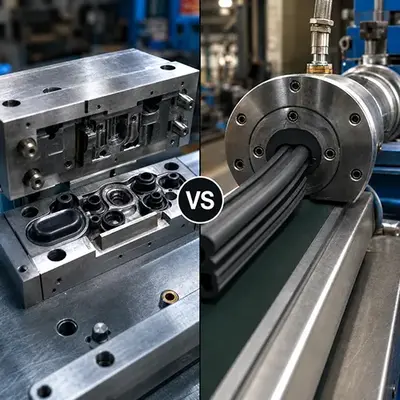
When developing a new component or sourcing custom rubber parts, one of the most critical decisions mechanical engineers and procurement teams face is choosing the right manufacturing process: Molded Rubber vs. Extruded Rubber.
While both manufacturing methods can process a wide range of elastomers—including EPDM, NBR, Silicone, and Viton (FKM)—they differ fundamentally in terms of tooling structure, dimensional tolerances, production costs, and component geometry. Selecting the wrong process can lead to unnecessary tooling expenses or parts that fail to meet performance requirements. As an experienced rubber manufacturer, we break down the core differences between rubber molding and rubber extrusion to help you make an informed decision for your project.

What is Molded Rubber?
The rubber molding process involves placing uncured rubber compound into a high-precision, closed metal mold cavity. Under heat and high pressure, the compound flows to fill the cavity and undergoes vulcanization. Common molding techniques include compression molding, transfer molding, and liquid rubber injection molding.
Key Features of Rubber Molding:
- Complex 3D Geometries: Ideal for manufacturing custom molded rubber parts with intricate features such as undercuts, holes, complex contours, and varying wall thicknesses.
- Tight Tolerances: Because dimensions are governed by a CNC-machined steel mold, molded components achieve exceptional dimensional consistency and superior sealing integrity (complying with RMA standards).
- Rubber-to-Metal Bonding: Easily supports overmolding rubber onto metal or plastic inserts for high-strength vibration damping and structural applications.
Typical Products: Precision rubber seals, rubber bushings, rubber mounts, rubber grommets, diaphragms, and suction cups.
What is Extruded Rubber?
Rubber extrusion is a continuous manufacturing process where heated, softened rubber compound is forced through a custom metal die with a specific profile orifice under pressure. The extruded profile then passes through a continuous curing oven for vulcanization. Similar to pushing toothpaste out of a tube, this process yields a continuous length of rubber with a uniform cross-section.
Key Features of Rubber Extrusion:
- Unrestricted Lengths: Allows continuous production of rubber strips, tubing, and gaskets over dozens or hundreds of meters, which can then be coiled or cut to specified lengths.
- Significantly Lower Tooling Cost: Fabricating a two-dimensional extrusion die is far less expensive and faster than machining a 3D steel mold, making it ideal for rapid prototyping or cost-sensitive projects with fixed cross-sections.
- High Output Efficiency: Continuous processing enables rapid production for high-volume linear applications.
Typical Products: Door and window weatherstripping, rubber tubing/hoses, U-channel edge trim, D-shaped door seals, and hollow perimeter gaskets.
Molded Rubber vs. Extruded Rubber: Key Comparison Table
To help your engineering team quickly select the optimal process, here is a breakdown of the core differences between these two manufacturing techniques:
| Evaluation Factor | Molded Rubber Parts | Extruded Rubber Profiles |
|---|---|---|
| Part Geometry | Complex 3D shapes, variable wall thickness, enclosed geometries | Uniform 2D cross-section, continuous linear lengths |
| Tooling Cost | Higher (requires precision CNC-machined steel/aluminum mold cavities) | Very Low (requires only a 2D steel die plate) |
| Dimensional Tolerances | Tight & Precision (RMA A1 / A2 tight tolerances) | Moderate (wider tolerances due to unrestrained expansion during continuous curing) |
| Multi-Material Capability | Excellent for rubber-to-metal or rubber-to-plastic bonding | Limited (primarily dual-durometer or co-extrusion of rubber) |
| Common Applications | Rubber Seals, Bushings, Mounts, Grommets | Weatherstripping, edge trim, rubber tubing, sponge rubber profiles |
How to Choose the Right Manufacturing Process for Your Project
When determining the best manufacturing route for your custom rubber parts, evaluate these three practical engineering criteria:
- Analyze the Cross-Sectional Geometry: If the profile remains constant throughout the entire length of the component (such as enclosure seals or door gaskets), rubber extrusion is the most economical choice. If the part features mounting holes, alignment bosses, asymmetrical surfaces, or enclosed ring shapes, rubber molding is mandatory.
- Evaluate Sealing Tolerance & Mechanical Stress: Applications requiring precise dimensional repeatability and high compression resistance—such as hydraulic systems, automotive suspensions, or semiconductor equipment—benefit from the structural stability offered by custom rubber molding.
- Consider Budget & Development Speed: Die development for extrusions is significantly faster and cheaper than constructing a steel mold for complex 3D parts. For large frame seals, vulcanized splicing of extruded profiles is often an effective strategy to avoid the heavy investment of massive molding tooling.
Frequently Asked Questions (FAQ)
Partnering with a Professional Rubber Manufacturer
Whether your project calls for high-precision custom molded rubber parts or high-volume extruded rubber profiles, partnering with an experienced rubber manufacturer capable of custom compound development and DFM (Design for Manufacturability) review is essential for seamless mass production.
If you have questions regarding 2D/3D engineering drawings or physical sample evaluation, contact our technical engineering team today for DFM review and competitive quotation.
Other News
Rubber-to-Metal Bonding Design Guide: Enhancing Shear Strength and Durability in Custom Seals
2026/09/11
Medical & Food Grade Rubber Certification: FDA, USP Class VI & ISO 10993 Guide
2026/08/27
OEM/ODM Customized Rubber Parts Development Process: 6 Steps from 2D/3D Drawings to Mass Production
2026/08/12
Top 10 Applications of Custom Rubber Parts Across Industries: Enhancing Performance & Durability
2026/07/21
Achieving High-Speed Stable Gripping: How to Select Rubber Vacuum Suction Cups for Stability and Longevity in Robotic Systems
2025/12/03
O-Rings, Bellows, Dust Boots: 【One-Minute Guide】Correct Application Scenarios for Rubber Sealing Components
2025/10/20

Rubber Components and Noise Control: Reducing Sound and Vibration Across Industries
2025/07/22

Top 5 Medical Rubber Applications Revealed – The Elastic Technology Behind Modern Healthcare
2025/06/06

Unsung Heroes of Your Vehicle: The Complete Guide to Rubber Automotive Parts
2025/05/15

A Complete Guide to Industrial Rubber Seals, Gaskets, and Vibration Dampers
2025/03/28

What Makes Rubber Bellows So Essential?
2024/12/20
Types of Rubber Materials Used in Seals and Their Applications
2024/12/13