

OEM/ODM Customized Rubber Parts Development Process: 6 Steps from 2D/3D Drawings to Mass Production
2026/08/12
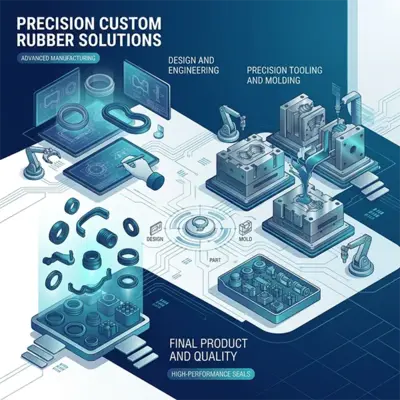
In product development and industrial manufacturing, custom rubber parts play a mission-critical role—whether as watertight sealing gaskets, vibration dampers, or heavy-duty protective boots. However, procurement managers and mechanical engineers frequently encounter hurdles such as drawn-out lead times, costly tooling re-works due to dimensional discrepancies, or premature material failure under harsh environments.

As a leading OEM / ODM rubber manufacturer, we bring full transparency to the custom component engineering lifecycle. Through our standardized 6-step manufacturing framework, we help engineering and procurement teams shorten development cycles, optimize tooling budgets, and guarantee 100% compliance with strict design specifications.
Step 1: Technical Requirement Evaluation & DFM Review
Successful custom development begins with rigorous pre-production analysis. Upon receiving your 2D engineering drawings (STEP, DWG, PDF) or 3D CAD models (IGES, STP), our engineering team conducts a thorough Design for Manufacturability (DFM) review:
- Geometry & Draft Angle Analysis: Evaluating part geometry for optimal molding or extrusion feasibility, while optimizing flash line placement and draft angles to prevent tearing during demolding.
- Dimensional Tolerance Review: Rubber compounds experience thermal shrinkage after vulcanization. We cross-reference tolerances against RMA (Rubber Manufacturers Association) standards to ensure dimensional consistency throughout mass production.
- Operating Environment & Elastomer Matching: Recommending the ideal raw elastomer based on actual operating conditions (contact fluids, working temperatures, UV exposure, or FDA food-grade compliance).
Step 2: Custom Elastomer Compound Formulation
The mechanical performance of custom rubber components—including Shore A hardness, tensile strength, elongation, and compression set—depends directly on the rubber formulation. Beyond standard compounds, we offer tailored material development for demanding OEM/ODM applications:
| Common Elastomer Material | Key Physical Properties & Advantages | Typical Applications |
|---|---|---|
| EPDM | Exceptional weatherability, ozone resistance, steam resistance, and aging stability. | Outdoor weatherstripping, automotive window seals, architectural gaskets. |
| NBR (Nitrile) | Superior petroleum oil resistance, high wear resistance, and strong mechanical toughness. | Oil seals, O-rings, hydraulic gaskets, fuel system seals. |
| Silicone (VMQ) | Wide thermal stability (-60°C to +230°C), non-toxic, odorless, excellent biocompatibility. | Medical device components, food-grade seals, electronic waterproof gaskets. |
| FKM / Viton® | Extreme heat resistance (up to 250°C) and outstanding resistance to aggressive acids, fuels, and solvents. | Semiconductor equipment seals, aerospace seals, chemical processing parts. |
Step 3: Tooling Design, CAD/CAM Modeling & Mold Fabrication
Mold precision directly determines final component quality and production efficiency. Following DFM approval and compound selection, we proceed with high-precision tooling manufacturing:
- 3D Mold Construction Design: Incorporating precise thermal expansion and volumetric contraction factors into runner systems, air vents, and ejector mechanisms.
- Precision CNC Tooling Machining: Utilizing 3-axis/5-axis CNC high-speed milling and EDM machining to maintain mold cavity tolerances within ±0.01mm.
- Surface Finishing: Applying cavity polishing, sandblasting, or chrome plating to achieve desired surface aesthetics and smooth part release.
Step 4: Trial Sampling & First Article Inspection (FAI) Report
Once tooling is complete, we run initial trial sampling (T1 Sample Production). Sampling serves not only to produce physical prototypes but also to validate cure cycles, temperature profiles, and molding pressure parameters:
- Prototype Dispatch for Assembly Testing: Shipping T1 samples directly to your team for physical fitment, sealing performance, and field testing.
- Comprehensive Inspection Documentation: Accompanying samples with a full FAI (First Article Inspection) report, full-dimension CMM inspection data, and compound material test certificates (RoHS / REACH / Cpk data).
Step 5: Mass Production & Quality Control (QC & QA)
Upon client sample sign-off, the project transitions into mass production. To guarantee lot-to-lot consistency, our production facility adheres to strict quality assurance protocols:
- Automated Vulcanization Molding: Utilizing automated PLC curing controllers to eliminate operator variation in temperature and dwell time.
- Advanced Deflashing Post-Processing: Depending on part geometry, employing manual trimming, die-cutting, or cryogenic deflashing to yield clean, flash-free edges.
- AOI & Statistical Quality Checks: Conducting automated optical inspection (AOI) on critical dimensions while regularly auditing durometer hardness and tensile strength.
Step 6: Customized Packaging & Global Logistics Delivery
Finally, we offer custom packaging solutions tailored to product protection requirements—such as anti-static bags, vacuum sealing, anti-tack powder treatments, or specified unit counts—preventing deformation or sticking during international freight. We support FOB, CIF, DDP, and other Incoterms to deliver high-quality parts smoothly to your facility worldwide.
Why Partner with Us for Your OEM / ODM Custom Rubber Parts?
Custom rubber development is more than purchasing raw materials or tooling—it is a technical partnership uniting material science with precision engineering. Leveraging extensive manufacturing experience in custom rubber parts, we offer:
- Proactive Engineering Support: Identifying potential manufacturing risks before cutting steel, saving you expensive tooling modification fees.
- In-House Compound Formulation: Operating proprietary compounding equipment and a vast formula database to rapidly meet unique physical property requirements.
- Traceable Quality Systems: ISO-certified manufacturing implementing comprehensive lot traceability from raw polymer to final dispatch.
Ready to Kick Off Your Custom Rubber Project?
Whether you have completed 2D/3D CAD drawings, conceptual sketches, or physical samples for reverse engineering, our technical team is ready to deliver an immediate DFM review and competitive quote.
👉 Upload your drawings or contact our engineering team today!
Other News
Rubber-to-Metal Bonding Design Guide: Enhancing Shear Strength and Durability in Custom Seals
2026/09/11
Medical & Food Grade Rubber Certification: FDA, USP Class VI & ISO 10993 Guide
2026/08/27
Molded vs. Extruded Rubber: Manufacturing Process & Applications Guide
2026/07/23
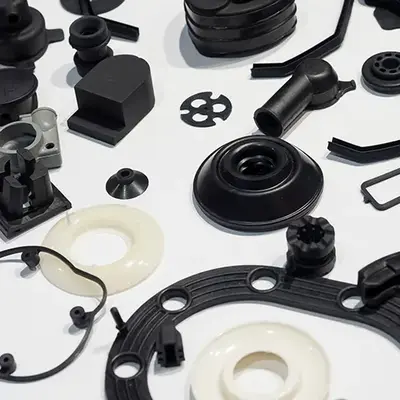
Top 10 Applications of Custom Rubber Parts Across Industries: Enhancing Performance & Durability
2026/07/21
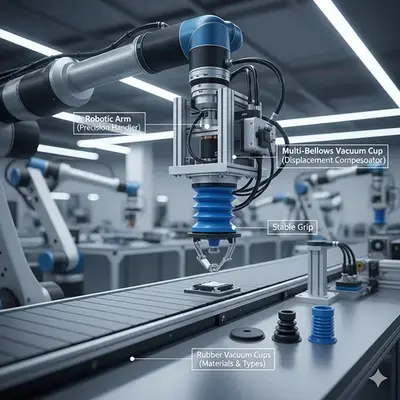
Achieving High-Speed Stable Gripping: How to Select Rubber Vacuum Suction Cups for Stability and Longevity in Robotic Systems
2025/12/03
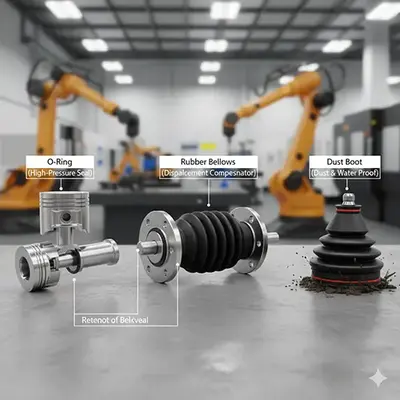
O-Rings, Bellows, Dust Boots: 【One-Minute Guide】Correct Application Scenarios for Rubber Sealing Components
2025/10/20
Rubber Components and Noise Control: Reducing Sound and Vibration Across Industries
2025/07/22

Top 5 Medical Rubber Applications Revealed – The Elastic Technology Behind Modern Healthcare
2025/06/06
Unsung Heroes of Your Vehicle: The Complete Guide to Rubber Automotive Parts
2025/05/15

A Complete Guide to Industrial Rubber Seals, Gaskets, and Vibration Dampers
2025/03/28

What Makes Rubber Bellows So Essential?
2024/12/20
Types of Rubber Materials Used in Seals and Their Applications
2024/12/13