

Rubber-to-Metal Bonding Design Guide: Enhancing Shear Strength and Durability in Custom Seals
2026/09/11
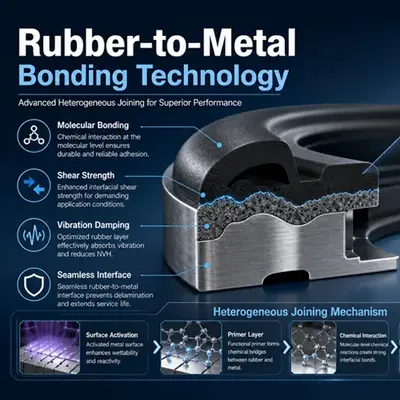
In automotive suspension systems, industrial anti-vibration mounts, pump valves, and aerospace sealing assemblies, rubber-to-metal bonding (rubber encapsulation) plays a mission-critical role. This hybrid component architecture combines the structural rigidity of metals (steel, aluminum, brass) with the dynamic damping, sealing capability, and elastomeric recovery of rubber. However, under prolonged high-frequency vibration, alternating mechanical stress, and aggressive fluid exposure, interfacial delamination and insufficient shear strength remain leading causes of component failure.
As a professional custom rubber manufacturer, we provide a deep dive into interfacial chemical bonding, surface preparation, adhesive selection, and compression molding techniques to help engineering teams substantially increase the shear strength and peel strength of rubber-bonded metal components.

1. Physical and Chemical Mechanisms of Heterogeneous Bonding
Relying solely on "mechanical interlocking" formed during compression molding is insufficient to withstand high dynamic shear loads. To achieve an optimal bond—defined by "Rubber Tear" (where adhesion strength exceeds the tensile strength of the elastomer itself)—robust covalent chemical bonds must be established at the substrate interface:
- Primer Layer: Applied directly to the metal surface, primarily formulated with phenolic resins or organosilanes to form strong chemical linkages with metal oxides.
- Covercoat / Bonding Adhesive: Contains polymers and active crosslinking agents that co-vulcanize with the rubber polymer chains during molding, forming an irreversible 3D crosslinked network.
2. 4 Critical Process Steps Determining Interfacial Shear Strength
The bonding quality of rubber-molded metal parts depends heavily on precise process control. A oversight in any single stage can drastically reduce interfacial adhesion:
- Meticulous Metal Surface Preparation: Oil contaminants and oxide layers hinder chemical bonding. Metal inserts must undergo solvent degreasing followed by sandblasting / shot blasting (Ra 3.2–6.3 µm) to significantly increase surface area and create micro-roughness.
- Precise Adhesive Coating and Drying Control: Utilizing automated spraying or dipping to strictly manage film thickness (typically 10–25 microns). Insufficient thickness causes unbonded zones, while excess thickness creates a brittle weak boundary layer.
- Pre-Heating and Contamination Control: Coated metal inserts are dried in climate-controlled environments. Bare-hand contact with bonding surfaces prior to molding is strictly prohibited to prevent skin oil contamination.
- Vulcanization Parameter Optimization (Temperature, Pressure & Cure Time): Molding pressure must ensure fluid rubber fully wets and compresses against the metal interface while co-vulcanization cures both the adhesive and the elastomer simultaneously.
Common Metal Substrates and Compatible Elastomers
| Metal Substrate | Recommended Elastomers | Key Pretreatment & Bonding Considerations |
|---|---|---|
| Carbon Steel / Iron | NR, NBR, EPDM, FKM | Primer must be applied immediately post-grit blasting to prevent flash rusting. |
| Stainless Steel | Silicone, FKM, EPDM | Dense passive oxide layers require chemical pickling or specialized silane coupling agents. |
| Aluminum Alloys | NR, NBR, Silicone | Requires anodizing or conversion coating to prevent aluminum oxide powdering and bond failure. |
| Brass / Copper | NR, NBR | Copper ions accelerate rubber degradation; requires specialized inhibitors within the adhesive system. |
3. Critical DFM Guidelines for Structural Engineers
Beyond material selection and chemical preparation, part geometry dictates shear stress distribution. Optimizing structural design during Design for Manufacturability (DFM) significantly minimizes stress concentration:
- Eliminate Sharp Edges & Right Angles: Design edge radii on metal inserts (Fillet Radius: R ≥ 1.0 mm) to distribute localized edge tear forces evenly.
- Incorporate Mechanical Interlocks: Add chamfers, through-holes, or grooves on metal inserts. Rubber flowing through holes forms a "bridge lock" for dual structural security.
- Optimize Mold Flow and Overflow Zones: Position parting lines away from primary load-bearing bonding areas to prevent micro-air traps at the interface.
4. Adhesion Strength Testing Standards (ASTM Compliance)
To ensure bonded components withstand extreme operating conditions, rigorous destructive testing is conducted according to international standards:
- ASTM D429 Method A / B (Peel Adhesion Test): Evaluates the force required to peel rubber from a rigid metal substrate at 90° or 180°. Quality standards demand 100% Rubber Failure (R-100).
- ASTM D429 Method C (Parallel Plate Shear Test): Simulates dynamic parallel shear loads on shock mounts under maximum compression.
- Salt Spray and Environmental Aging Tests: Verifies that bonded interfaces resist electrochemical corrosion (ASTM B117) and chemical degradation in hot oil environments.
Developing High-Strength Rubber-to-Metal Bonded Components?
Our engineering team brings extensive expertise in heterogeneous bonding technology. Contact us today for metal pretreatment guidance, adhesive matching, and complete DFM evaluations.
👉 Contact Our Technical Experts for Custom Bonding Evaluations!
Other News
Medical & Food Grade Rubber Certification: FDA, USP Class VI & ISO 10993 Guide
2026/08/27
OEM/ODM Customized Rubber Parts Development Process: 6 Steps from 2D/3D Drawings to Mass Production
2026/08/12
Molded vs. Extruded Rubber: Manufacturing Process & Applications Guide
2026/07/23
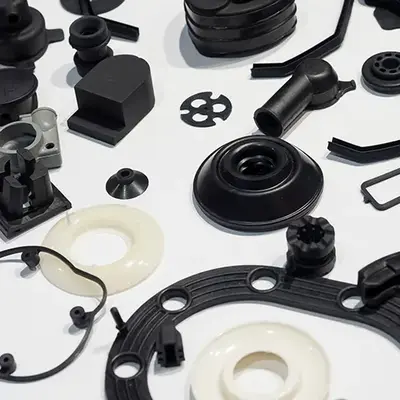
Top 10 Applications of Custom Rubber Parts Across Industries: Enhancing Performance & Durability
2026/07/21
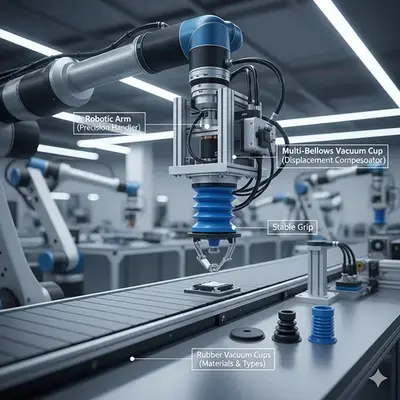
Achieving High-Speed Stable Gripping: How to Select Rubber Vacuum Suction Cups for Stability and Longevity in Robotic Systems
2025/12/03
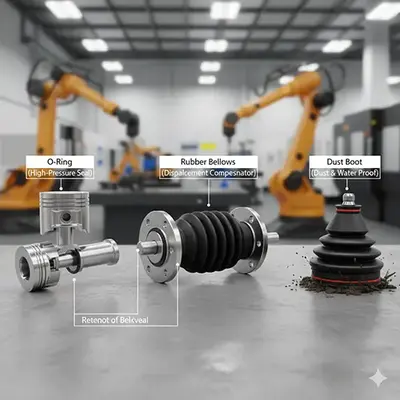
O-Rings, Bellows, Dust Boots: 【One-Minute Guide】Correct Application Scenarios for Rubber Sealing Components
2025/10/20
Rubber Components and Noise Control: Reducing Sound and Vibration Across Industries
2025/07/22

Top 5 Medical Rubber Applications Revealed – The Elastic Technology Behind Modern Healthcare
2025/06/06
Unsung Heroes of Your Vehicle: The Complete Guide to Rubber Automotive Parts
2025/05/15

A Complete Guide to Industrial Rubber Seals, Gaskets, and Vibration Dampers
2025/03/28

What Makes Rubber Bellows So Essential?
2024/12/20
Types of Rubber Materials Used in Seals and Their Applications
2024/12/13